
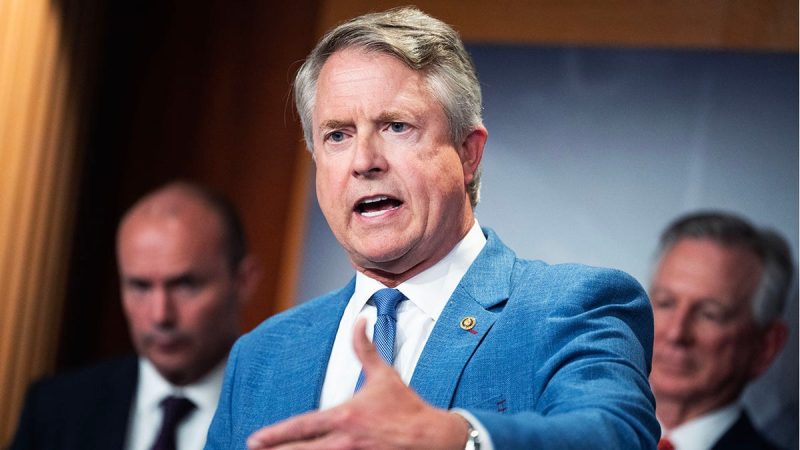
While Senate Republicans work to coalesce behind a fix to expiring Obamacare subsidies, one Republican has a plan that he says bridges Democrats’ desires and GOP demands.
Sen. Roger Marshall, R-Kan., detailed his plan, dubbed the Marshall Plan, in an interview with Fox News Digital that he pitched as a starting point that could bring both Republicans and Democrats to the table to hash out a bipartisan solution to the subsidies, and further, Obamacare as a whole.
Boiled down, Marshall’s legislative package would do two things: extend the enhanced subsidies as they are for one year, and then convert those subsidies into health savings accounts (HSAs).
That approach, in broad terms, bridges the gap between Senate Democrats’ desire to extend the subsidies and the GOP’s wishes to pivot the subsidy money into HSAs, which has the backing of President Donald Trump.
‘We want to turn patients into consumers again. That’s the whole key here: My plan doesn’t impact just the 24 million people on Obamacare. It’s going to impact everybody’s cost of health care,’ Marshall said. ‘So if we pair bumping up savings accounts with price tags, we’re going to turn patients into consumers again, and they’ll do magic things out there. I think of this being like the magic shopping weeks, Black Friday and Cyber Monday.’
Along with extending the enhanced subsidies and transitioning them to HSAs, Marshall’s plan would also eliminate zero-cost premiums by requiring a minimum payment of $5 per month, require people to provide a government-issued ID in a bid to eliminate fraud, and include stricter enforcement of Hyde Amendment requirements that taxpayer dollars don’t fund abortions by denying the premium credits from being used on abortion procedures.
Abortion funding has proven a tricky situation in ongoing bipartisan talks, a point Marshall acknowledged but countered that he couldn’t understand ‘why by just stating what the law is and making it even clearer,’ Democrats object to it.
The plan would also bar gender transition procedures from being covered by plans on the Obamacare exchange and permanently fund cost-sharing reduction payments, which Marshall and several economists who reviewed his plan estimated would save $30 billion on healthcare and lower premiums by roughly 11%.
The end of the one-year extension of the subsidies would also include a wind-down transition period until 2032, reducing the enhanced premium tax credits each year by 20%.
The Obamacare issue is one that Marshall has thought about for over a decade and tried to tackle legislatively when he was a member of the House.
‘Forever, it feels like it’s been forever,’ Marshall said. ‘Here we are, 15 years later, premiums have doubled. Out-of-pocket costs — it went from $1,000 a year to $15,000 a year.’
While he hopes for a bipartisan product at the end of the road, Marshall’s main objective is to present a package that can get strong support among his Republican colleagues. Senate Republicans are expected to discuss which option they want to run with during a closed-door meeting on Tuesday.
He noted that bipartisan talks had picked up recently, but that Senate Minority Leader Chuck Schumer, D-N.Y., was proving to be a major roadblock.
‘I think the talks are increasing, and they’re getting better, but there’s a political reality to this as well,’ Marshall said. ‘I don’t think Chuck Schumer wants us to be successful. He doesn’t want us to fix Obamacare. He wants this country to be in chaos come November of next year.’
It’s also one of several Republican plans in the mix, with others either focusing only on abandoning the enhanced subsidies for HSAs or extending the subsidies for two years.
And time is running out for Republicans to present their plan to counter Senate Democrats’ proposal, with a vote on the subsidies set for Thursday. That could be a tall task for Republicans, Marshall said.
‘I think it’ll be really hard to have enough momentum to get something that’s going to allow the enhanced premiums to continue,’ he said. ‘I want to emphasize, though the original Obamacare is still in place, and it’s going to cover over 80% of people’s premiums as is. I think we need to do more than just stop the hemorrhaging. Our bill stops the hemorrhaging.’