
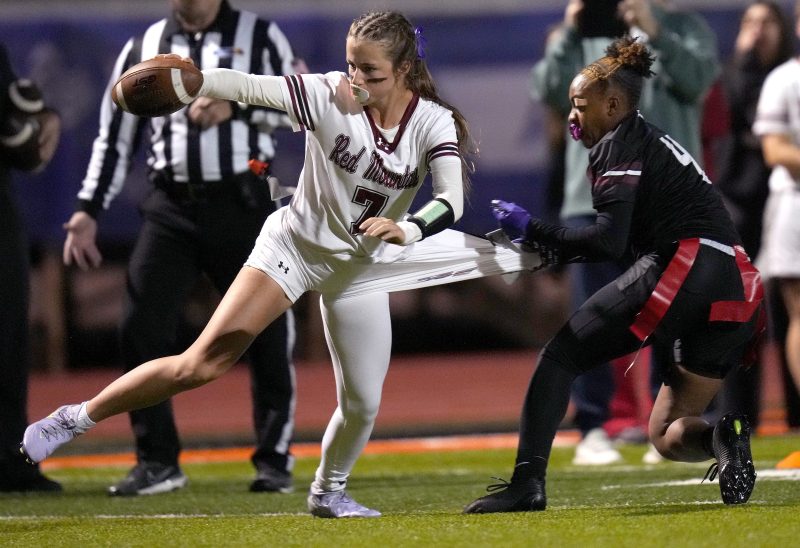
Flag football will make its Olympic debut at the 2028 Los Angeles Games.
USA Football is holding talent identification camps across the country to find potential Olympic athletes.
Current national team members and interested NFL players must go through a qualification process to make the Olympic roster.
Flag football is one of the fastest growing sports in the U.S., with participation increasing significantly among women and girls, but lacks an established elite athlete pipeline.
SPRING, TX — Callie Brownson tugged at the brim of her black USA Football cap and surveyed the dozens of Olympic hopefuls who knelt at her feet on a turf field in a suburban recreational sports complex.
“We’re also looking for people worthy of wearing those three letters across your chest,” Brownson said.
Flag football, known colloquially as “flag,” is one of the fastest-growing sports in the United States, where it is gaining traction mainly among women and girls. However, flag still lacks an established athlete pathway comparable to longtime Olympic sports that boast vast networks of youth clubs, college teams and high-powered professional leagues.
In the run-up to the L.A. Games, officials at USA Football, the national governing body responsible for tackle and flag football, are scouring the country for untapped potential by holding regional talent identification camps open to adults and kids ages 11 to 17.
Brownson, a former Cleveland Browns assistant wide receivers coach, was the first woman to coach an NFL position group in a regular-season game and the first woman to coach full-time in NCAA Division I college football at Dartmouth. She also coached the U.S. women’s tackle football team to a world championship in 2022 and as a player won two world gold medals in 2013 and 2017 with the national tackle team.
“Something I never even fathomed through my time of playing and coaching is that we would ever be using the term ‘football’ in the Olympics, and now we are,” Brownson said. “I think it’s just an incredible moment.”
USA Football gets its Olympic moment, looks to the future
USA Football’s mission is to ensure that flag football endures beyond a moment. The Dec. 7 talent identification camp in Spring, located about an hour north of Houston, was the fourth of 12 camps scheduled through next spring. At the afternoon adult session, 80 athletes – 60 women and 20 men – showed up in cleats and ran through combine tests, one-on-one drills, five-on-five drills and scrimmages.
Before the camp commenced, Brownson asked the group a question: “Who here has dreamed of being on a medal podium?” Every athlete raised a hand.
Although 10-person Olympic flag football rosters won’t be set until 2028, the 2026 calendar year is massively significant for USA Football’s preparation. Athletes attending the talent identification camps are fighting for invitations to trials in March, to be followed by a series of national team training camps next spring and summer.
From there, USA Football will select two 12-person rosters to compete for the men’s and women’s national teams next August at the 2026 International Federation of American Football (IFAF) World Championship in Germany, where the top three teams earn an automatic Olympic bid.
USA Football isn’t starting from scratch. The American men’s and women’s flag national teams are both global juggernauts; the men have won five consecutive world championships and the women have won the last three world championships. The U.S. men are No. 1 in the 2025 IFAF world rankings, while the U.S. women are ranked No. 2 behind Mexico.
But Brownson believes that expanding the player pool to bring in new blood is paramount to the program’s success and longevity.
“It’s not just survive 2026, it’s put together programs that are Olympic-caliber so that we are starting that process now and not waiting until we select the teams in 2028 to say, ‘OK, now we got to get into that mindset,’” Brownson said. “Everybody needs to prepare as if the Olympics are right now.”
NFL teams voted in May to allow NFL players to participate in flag football at the Olympics, with Miami Dolphins wide receiver Tyreek Hill and Green Bay Packers defensive end Micah Parsons among those expressing interest – though there are no guarantees they’d make the team. USA Football has full authority over roster selection and NFL players must go through a qualification process, though Brownson said the two organizations are still working through the specifics of that process, which she deemed “ever-evolving.”
And what about the current members of the reigning world champion U.S. men’s and women’s national teams? They’ll have to earn their spots on the Olympic roster, too – which is totally fine, said two-time gold medalist Amber Clark-Robinson, who plays defensive back and wide receiver.
“You got to have the best of the best regardless,” Clark-Robinson said. “Like who knows, I might not even be there. At the end of the day, gold is the goal. And if you don’t fit that mold, it’s no hard feelings. Especially as a competitor, you have to understand sometimes it’s not your time, you know? So I think it might shake it up a little bit, but at the end of the day, you have to respect the process.”
Building a flag football Olympic pipeline
Fans tuning in to Olympic flag competition will see a game that is not unrecognizable from the NFL games that regularly grace their screens, albeit with key differences.
Flag football is a non-contact, five-on-five game played on a field half the size of a tackle football field. As a result, flag is much faster than tackle and emphasizes technique over physicality.
Other unique characteristics: Flag doesn’t have special teams, only offense and defense. Quarterbacks can’t run unless there’s a handoff first but they can receive passes, meaning some plays can have multiple quarterbacks. There’s also a designated blitzer seven yards off the ball who has an unimpeded path to the quarterback. Lateral passes are allowed but blocking and screening are not.
Clark-Robinson played three seasons of tackle football for the Atlanta Steam in the Legends Football League, then pivoted to flag after that league shut down during the pandemic. The transition wasn’t as smooth as she’d anticipated.
“It was rough,” Clark-Robinson said. “I couldn’t pull a flag to save my life. I was very contacty – I had a bunch of people that called me ‘The Wrecking Ball’ because I wasn’t trying to (hit), but I was just in the mindset of being so physical. So it was definitely a switch that had to be flipped to dial back.”
Sunday’s camp in Texas attracted players from states as far away as Illinois and included players with backgrounds in football, track and field, soccer, basketball and lacrosse.
While prior flag experience is considered a plus when evaluating players, USA Football is also targeting what they call “elite athlete talent transfer” – athletes who played other sports at a collegiate level or above. Clark-Robinson was a high school basketball state champion and college track and field athlete. Brownson said basketball players adapt well to flag football because of the similar physicality and pace.
The testing portion of the talent ID camp contained drills designed to emphasize translatable skills, such as the 5-10-5 shuttle drill that forces athletes to change direction within short distances, as well as exercises like a 20-yard dash and broad jump to measure athleticism.
After that, they moved on to individual flag-specific drills that assess a player’s ability to evade flag pulls, run routes and throw accurate passes. The final component was scrimmages to see how athletes operated in a game setting.
“We kind of crawl, walk, run in how we evaluate and assess them,” Brownson said.
Flag football participation surging with boost from women, girls
On an adjacent field, kindergarten-age boys and girls in colorful uniforms played flag football in a local league – the type of organization USA Football hopes will be a foundation for the sport’s continued development.
From 2015 through 2024, there was a 37% increase in flag participation among children ages 6 to 17, according to a USA Football analysis of the Physical Activity Council’s Annual Participation study data.
Women and girls are driving growth at the high school and college levels. Sixteen states have sanctioned high school girls’ flag football as a varsity sport, while 17 other states and the District of Columbia have independent pilot programs. At the collegiate level, the NAIA offers women’s flag football scholarships and granted the sport invitational status. The NCAA will vote next month on whether to add flag to its Emerging Sports for Women program in all three divisions, a step toward eventual championship status.
“I think the interest has always been there, they just never had the space to do it,” Clark-Robinson said. “I think more girls are gravitating towards it because, ‘Hey, there are girls like me out here. I thought I was the only one but no, there’s 100 other girls just in the same area as me.’”
USA Football wants to tap into that interest and continue to provide opportunities. Darrell “D.K.” Taylor, the national team development program director, said USA Football works with local club teams, NFL flag programs and colleges to find athletes and coaches who can be part of the national team feeder system. Top performers from the youth talent identification camps will earn invites to USA Football’s annual Select Bowl, a precursor to selection for junior national teams.
“Our goal is to unearth any possible way to identify talent in order to bring them as a part of the national team development program, so that we can make sure our eyes are on them, and then they continue to develop to one day be a part of our national team,” Taylor said.
Taylor said NFL markets generally have the most robust flag football infrastructure, and each of USA Football’s talent identification camps are co-hosted with a local NFL team.
The Houston Texans expanded their girls flag football program to more than 80 high schools across Texas this year. Earlier this month, the New York Jets granted $1 million to the Eastern College Athletic Conference to launch a 15-team collegiate women’s flag league in 2026.
Higher youth participation rates can have a trickle-up effect, where athletes who are given increased access to flag at a younger age perform at a higher level and enrich the sport’s talent pool.
Clark-Robinson is in her fourth season as head coach of the women’s flag team at the University of Saint Mary, an NAIA school in Leavenworth, Kansas. She said she is just now starting to see college players who played flag competitively in high school. As far as she’s concerned, the earlier they start, the better.
“You can see the difference in these 14 year olds, these 13 year olds, because they’ve been playing for four or five years already,” Clark-Robinson said, gesturing to the field where the youth talent camp had just finished. “And when they get to college, they’ll have 10 years of experience before they even have to step on the football field there.”
If USA Football’s efforts to expand its reach are successful, the Los Angeles Games will be just the beginning for flag.
“Winning in 2028 is important, but there’s no future after 2028 if we don’t build a structured pathway and provide as many opportunities as we can,” Brownson said.
Clark-Robinson said the Olympics are a golden opportunity for flag to gain widespread exposure and rewire misguided perceptions of the sport.
“I’m excited for people to actually take it seriously and see that flag is something that can be competitive and exciting to watch. It’s not just a ‘powderpuff’ sport,” Clark-Robinson said. “Just go ahead and hop on board. Don’t wait.”