
NFL rookies deserve the benefit of the doubt when it comes to assessing their first impressions.
Adapting to the rigors and complexity of pro football is no easy feat, and any turbulence in navigating that process is not necessarily indicative of persistent trouble. Still, with the 2025 regular season almost complete, it’s time to look back on how last April’s top picks all fared.
This was a class short on star power, and that dynamic was largely reinforced throughout the season. While several players emerged right away as key contributors, only one rookie was selected to the Pro Bowl: the Tennessee Titans’ Chimere Dike, who made it as a returner. But while there might not have been a transcendent talent on the level of someone like Jayden Daniels or Brock Bowers last year, the Day 1 crop largely impressed with early returns.
Here are the grades for every first-round pick in the 2025 NFL draft after 17 weeks:
1. Cam Ward, QB, Tennessee Titans: B
A glimpse at the raw facts – a fired coach, tying for the league-high with 55 sacks taken and a passing offense that ranks 30th in yards per game – might lead one to conclude Ward’s debut campaign was an abject failure. But the top pick showed remarkable resiliency in the face of extremely difficult circumstances. Despite lacking any consistent help up front or from Tennessee’s skill-position crew, Ward has made magic happen with daring downfield throws and a knack for making something out of nothing by extending plays. Saints edge rusher Chase Young even re-upped the persistent Patrick Mahomes comparisons after last week. Of course, Ward has a good deal of work to do to put himself on a comparable trajectory to the three-time Super Bowl MVP, and the Titans’ subpar setup has exacerbated issues with his erratic ball placement and proclivity for going into hero mode rather than operating within structure. But Ward’s peak performance has been more than enough for the next coaching staff to be encouraged about what it will inherit.
2. Travis Hunter, WR/CB, Jacksonville Jaguars: Incomplete
With his season cut short by a noncontact knee injury that landed him on injured reserve on Halloween, Hunter and his iron man act ended up as more of a curiosity this fall rather than the full-scale spectacle many envisioned. The 2024 Heisman Trophy winner deserves a reprieve given his singular undertaking, but Jacksonville’s plan to juggle his workload at wide receiver and cornerback – with the bulk of snaps coming at the former spot – left much to be desired. With a full recovery, Hunter could still take his place as a playmaker without peer in this class. But after Jakobi Meyers’ extension following his midseason arrival via trade and Parker Washington’s emergence, there’s even more reason for the Jaguars to push him toward more action on defense.
3. Abdul Carter, OLB, New York Giants: B
Sacks didn’t come in droves for Carter, who didn’t net his first full one until December and has just four on the season. But he has 3 ½ in his last four contests, and his 66 pressures – which ranks eighth among all players – better illustrate his effectiveness as a pass rusher. Still, Carter’s campaign has been clouded by interim coach Mike Kafka benching him twice for the start of games as a disciplinary measure. He’ll have to figure out how to better parlay his initial disruptiveness into a better finishing touch, but a breakout could be ahead in Year 2 if he aligns himself well with a new coaching staff.
4. Will Campbell, OT, New England Patriots: B
Drake Maye’s ascension to potential NFL MVP entailed a variety of factors, with many of them a credit to the quarterback himself. But Campbell’s performance has unquestionably given the second-year signal-caller a boost. His stellar protection has helped Maye take his place as arguably the league’s premier deep passer. The left tackle missed the last four games with a knee injury, but he’s set to return for the franchise’s postseason appearance since 2021.
5. Mason Graham, DT, Cleveland Browns: B-
It’s rare for a top-five selection to be perhaps the most overlooked part of a rookie draft class. Yet that might be the case with Graham, who has been outshone by Defensive Rookie of the Year front-runner Carson Schwesinger and tight end Harold Fannin Jr., among others. Graham had a rough early go but still has shown some promise as an interior disruptor in the passing game. Cleveland surely would have liked more substantial returns right away, particularly as Myles Garrett continues to command a good deal of attention as he pursues he single-season sack record. But there’s no reason for concern.
6. Ashton Jeanty, RB, Las Vegas Raiders: C
Grading Jeanty is a difficult proposition for the same reason that taking him this high carried significant risk: How can you assess a position that can only do so much to transcend its surroundings? The Heisman Trophy runner-up finisher’s arrival did little to repair an attack that remains the league’s least effective by almost any metric, as he boasts the lowest rushing success rate (32.5%) of all qualified players. But that’s largely a reflection of the Raiders’ inability to give Jeanty any room to run, with offensive coordinator Chip Kelly fired in late November as the attack continued to spin out. With 188 yards from scrimmage in Week 16, the talented all-purpose threat has still managed to serve up sporadic reminders of his immense promise. But it’s probably time for Las Vegas to merely leave this inauspicious debut behind, as the team looks poised to reconfigure both its offensive personnel and play-calling this offseason.
7. Armand Membou, OT, New York Jets: B
Known for being stout and reliable at Missouri, Membou made good on his reputation at the NFL level almost immediately. He quickly adapted to taking on pro pass rushers, and he remained a punishing presence in the ground game, earning the sixth-best run block win rate (80%) among all offensive tackles, according to ESPN. The line is perhaps the lone source of stability for Gang Green amid a personnel teardown, and Membou looks to be one of the lone few building blocks for the team moving forward.
8. Tetairoa McMillan, WR, Carolina Panthers: A-
All that pre-draft scrutiny surrounding McMillan was rendered moot rather quickly, as the towering wideout carried a still suspect passing attack that was woefully short on legitimate threats on the perimeter. The 6-5, 212-pound target answered many of the questions about his route-running with a much more polished approach than he showed at Arizona, making him an even more formidable downfield weapon than his frame and catch radius would suggest. But even while accounting for more than 30% of the team’s receiving yards, McMillan has perhaps hit the ceiling of what he can do to overcome the offense’s limitations through the air. In a class lacking any truly elite first-year players, however, he’d be a worthy Offensive Rookie of the Year selection.
9. Kelvin Banks Jr., OT, New Orleans Saints: B
The Texas product was one of the most surprising picks in the top 10, with some wondering whether he would be ticketed for a move to guard given his frame. But Banks has come on strong late in the season, helping the offense blossom after Tyler Shough took over as the starting quarterback at midseason. With Banks and Taliese Fuaga as bookend tackles, New Orleans has a stellar foundation up front for first-year coach Kellen Moore’s offense.
10. Colston Loveland, TE, Chicago Bears: B+
Plenty of parts of Ben Johnson’s offense didn’t coalesce until later in the season. Loveland, however, is just one of many promising young players on the unit to take off down the stretch. A major seam threat and red-zone weapon, he could become a focal point of the attack next season after battling to prove himself in the early going.
11. Mykel Williams, DE, San Francisco 49ers: Incomplete
Williams started nine games before suffering a season-ending torn anterior cruciate ligament. A work in progress as a pass rusher upon his selection, the former Georgia defensive end only recorded one sack and didn’t get an extensive opportunity to hone his craft. Williams, however, looked to be an emerging force against the run and generated pressure, particularly when working inside in obvious passing downs. He and Nick Bosa will both try to work their way back in 2026 to give San Francisco the formidable edge pairing that team leadership envisioned last spring.
12. Tyler Booker, G, Dallas Cowboys: B
There might not have been a more scrutinized pick in the first round, as Jerry Jones once again cut against the grain by taking the powerful yet athletically limited offensive guard at No. 12. Booker, however, largely looked at home in his initial foray against pros. The 6-4, 321-pounder was a driving force in the Cowboys’ rushing attack turnaround, and he held his own as a pass protector. While it’s still fair to question Dallas’ deployment of resources, Booker should be a staple of the front for some time.
13. Kenneth Grant, DT, Miami Dolphins: C
Grant started to put things together in Miami’s win over the Tampa Bay Buccaneers, generating four pressures and making his presence felt up front. Still, on the whole, the season has been a bit of a slog for the mountainous former Michigan lineman. Maybe that was to be expected for a player who was going to have to work on his conditioning and learn to become a more reliable contributor on a down-to-down basis. But Miami will be counting on him to set the tone against the run in a way he didn’t for most of his rookie year.
14. Tyler Warren, TE, Indianapolis Colts: A-
At one point this season, it looked as though Warren was a serious threat to become the first tight end to win Offensive Rookie of the Year, as he racked up 617 yards in Indianapolis’ sizzling 8-2 start. Then the offense unraveled, Daniel Jones got hurt, and Warren never reached 50 receiving yards in any of the Colts’ last six games. Still, he raises the floor of the passing attack several levels as a versatile threat who can break tackles and own the short-to-intermediate area.
15. Jalon Walker, OLB, Atlanta Falcons: B+
Moving Walker to the edge full-time paid off in a big way for both the rookie and the Falcons, who benefited greatly from his well-rounded work. His pass-rush production has waned a bit as teammate James Pearce Jr.’s has taken off, but he’s still one of the most complete and impressive rookies in the entire class.
16. Walter Nolen III, DT, Arizona Cardinals: Incomplete
Injuries colored what otherwise seemed like a promising rookie season for Nolen, who missed the first seven games of the season and then landed on injured reserve with a knee ailment. Despite only playing in six games, however, Nolen put together some impressive flashes by generating 13 pressures on 93 pass-rush plays. With Arizona dogged by injuries all season, Nolen figures to be one of several players who could come back strong in 2026.
17. Shemar Stewart, DE, Cincinnati Bengals: D+
At least the hyperathletic defensive end won’t end his rookie season without a sack. Stewart tallied the first of his career in a Week 17 win over the Cardinals, long past the point where his contributions would have made a difference for Cincinnati. Perhaps he should be extended some grace, given that he missed significant time with knee and ankle injuries. But there’s been little development for a player who needed plenty of it.
18. Grey Zabel, G, Seattle Seahawks: B
To pull off arguably the offseason’s most drastic overhaul, the Seahawks had to break with some recent tendencies. That included making a sizable investment in the interior line with Zabel in a move that ran counter to John Schneider’s established track record. Like many of Seattle’s moves, this one appears to have landed. Though Zabel couldn’t single-handedly lift up a rushing attack that didn’t find its stride until late in the year, he’s done superlative work in helping safeguard Sam Darnold.
19. Emeka Egbuka, WR, Tampa Bay Buccaneers: A-
His heroics in the opening weeks, which included five touchdowns in the first five games, put him in a class apart from his rookie peers. Since midseason, however, his production has slowed considerably, and he’s ceded his Offensive Rookie of the Year front-runner status. The downturn should mostly be attributed to the Buccaneers’ wider offensive issues, though Egbuka hurt his cause with a rash of drops. Still, even with a dwindling role down the stretch, he shapes up as another significant draft triumph for Jason Licht.
20. Jahdae Barron, CB, Denver Broncos: B-
Seeing a heavy workload right off the bat for one of the league’s most loaded defenses was always bound to be a stretch for any rookie. Barron has played in just 29% of the Broncos’ defensive snaps while seeing action in the team’s nickel and dime packages. He’s fared well in limited work, however, taking on an array of coverage assignments. He should continue to provide flexibility on the back end for Denver as a versatile piece capable of matching up with tight ends and receivers as well as making plays against the run.
21. Derrick Harmon, DT, Pittsburgh Steelers: B-
Separate knee injuries have forced the versatile defensive lineman to miss five games this year, but Harmon’s absences have only reinforced his value. Pittsburgh has struggled to stand up to the run when he’s been off the field, with the defense surrendering 217 yards on the ground in its initial tilt against the rival Ravens. Harmon still must grow as a pass rusher, but he at least gives the Steelers some semblance of a post-Cam Heyward future.
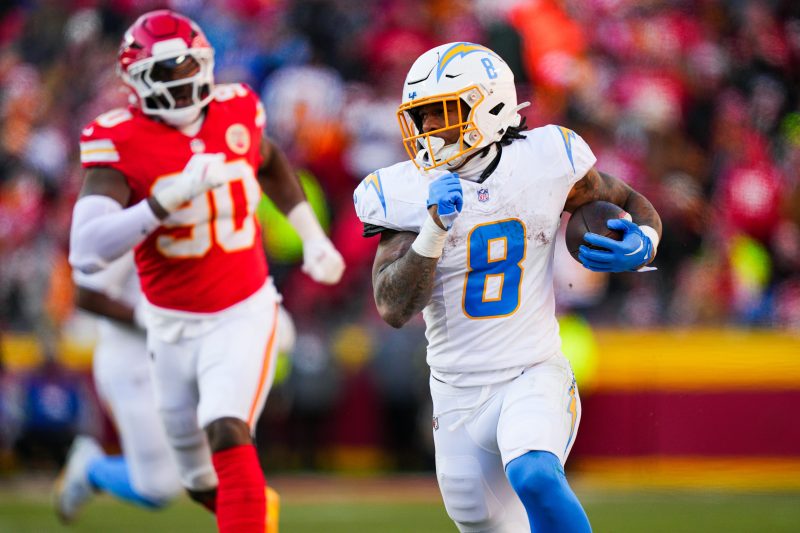
22. Omarion Hampton, RB, Los Angeles Chargers: B
Najee Harris’ torn Achilles looked as though it would thrust Hampton into a featured role in the early season, but the North Carolina product missed seven games with a fractured ankle suffered in Week 5. He returned to a timeshare with Kimani Vidal, but the Chargers’ offense has been thrown off balance by being without Joe Alt as well as Rashawn Slater at offensive tackle. Having shown signs of his all-purpose prowess and ability to shake off would-be tacklers for explosive runs, Hampton could be a solid candidate to break out in 2026 once he and the Bolts get their bearings.
23. Matthew Golden, WR, Green Bay Packers: C-
It’s clear that everyone got a little carried away in expecting that Golden would emerge as a go-to threat in a Matt LaFleur offense that doesn’t really afford that opportunity to any wideout, let alone a rookie. Yes, much more than 28 catches for 353 yards were expected of a player who looked the part of a top-line receiver in training camp. But it was reasonable to expect that the franchise’s first Day 1 receiver in 23 years would alter the complexion of the offense. Instead, he’s had more than 25 receiving yards in just one game since Week 8.
24. Donovan Jackson, G, Minnesota Vikings: B-
It’s been an extremely trying season for the Vikings’ offense, with J.J. McCarthy largely failing to find his footing behind an injury-riddled offensive line. But don’t pin the protection problems and unstable run game on Jackson. The former Ohio State standout had a rough introduction into the NFL that included a wrist injury in September, but he settled in and became a solid presence down the stretch on an otherwise suspect interior. Minnesota has plenty to evaluate about its offensive setup heading into next year, but it shouldn’t be concerned with Jackson’s development.
25. Jaxson Dart, QB, Giants: B-
Maybe this seems like a low mark for a player who was essentially the only source of hope for the Giants in a lost season. Dart, however, hasn’t enjoyed the same kind of progress as a pocket passer that some of his other peers in the class have. Despite providing Big Blue a sizable spark with his running ability, Dart will have to be a more composed and reliable presence under center next season and beyond. And while he’s waved off calls for him to dial back his devil-may-care running style, staying on the field will be a vital step in the early stages of his growth.
26. James Pearce Jr., OLB, Falcons: B
In setting the Falcons’ single-season rookie sack record and pacing all 2025 picks with 8 ½, Pearce has been exactly as advertised for a pass rush that needed his jolt. But he also remains a liability against the run, which has inhibited his utilization. Getting stronger and rounding out his game could go a long way toward making Pearce a consistent force. But the substantial cost of acquiring him continues to loom large for Atlanta, which looks poised to surrender a top-13 pick to the Los Angeles Rams after trading into this slot last April.
27. Malaki Starks, S, Baltimore Ravens: B
He was overshadowed by Nick Emmanwori, the uniquely athletic second-round safety who became a dynamic playmaker for the Seattle Seahawks. Still, Starks made a stellar impression with his heady play. He likely won’t ever approach the scintillating highs that Emmanwori will reach at times, but Starks offers a steadiness that is vital to a unit that has been too prone to meltdowns.
28. Tyleik Williams, DT, Detroit Lions: B-
Williams has started nine games this season, but he has participated in just 41% of the Lions’ defensive snaps. Consistency never quite clicked for Williams, but the defensive tackle seldom looked out of sorts.
29. Josh Conerly Jr., OT, Washington Commanders: B-
Conerly was headed for a much worse grade before turning things around later in the season. Washington hopes to see that progress carry over to 2026, when it can get a full reset on a disappointing year and try to equip Jayden Daniels for a bounce-back year.
30. Maxwell Hairston, CB, Buffalo Bills: B-
Having missed the first six games of the season and made just two starts, Hairston doesn’t have the extensive body of work of others on this list. He’s largely fared well in coverage, however, routinely sticking with receivers while showing some glimpses of his impressive ball skills. A larger role surely awaits next season, though the 5-11, 192-pounder will have to get stronger to avoid being exploited by bigger receivers and in the run game.
31. Jihaad Campbell, LB, Philadelphia Eagles: B
From his stunning performance at the open of the season to stepping up late in the year, Campbell has been impressive when filling in for the injured Nakobe Dean. His range and playmaking have been exceptional, though he’s had some costly lapses that help explain why he didn’t retain the role when Dean has been healthy. Still, Campbell is shaping up to be yet another hit for Howie Roseman and a significant asset for Vic Fangio’s defense.
32. Josh Simmons, OT, Kansas City Chiefs: B
Having played only eight games due to a wrist injury and personal issue, Simmons was bordering on an incomplete grade. But Kansas City saw enough of him to be plenty encouraged. At his peak, Simmons looks fully capable of being the upper-echelon pass protector Patrick Mahomes has long lacked at left tackle. More consistency is required, as are better showings as a run blocker, but he’s trending in the right direction.