
The NCAA lied. You’re shocked, I know. Amateurism was not the glue to college sports’ popularity.
Business booming for college football, as salaries soar and TV ratings remain strong.
Women’s sports are enjoying a moment amid NIL and pay-to-play, too.
The NCAA lied. You’re shocked, I know.
In a 2014 court filing, a lawyer for the NCAA arguing against NIL payments and pay-for-play asserted the association’s amateurism model was paramount to its popularity.
The lawyer claimed the NCAA’s “commitment to amateurism” helped “enhance the viewership of college athletics.”
That, we now know, is a farce. A myth. A whopper of a tall tale.
Whatever problems college sports might face in this modern world, unpopularity is not among them.
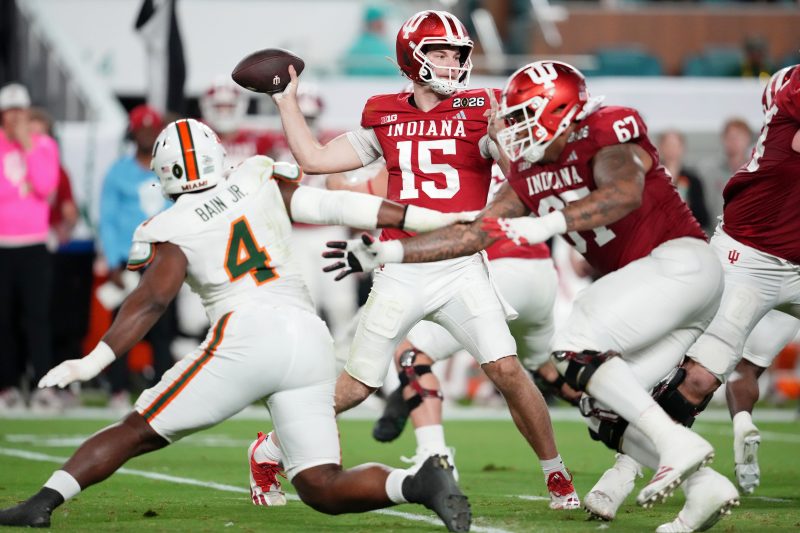
Television ratings for the Indiana-Miami national championship game paint a portrait of a booming enterprise. The game averaged 30.1 million viewers on ESPN, according to figures released by the network. Viewership peaked at 33.2 million sets of eyeballs.
That’s good for the second-most watched College Football Playoff national championship ever. It’s the most-watched non-NFL sporting event since a 2016 World Series Game 7.
America loves an underdog. Indiana captivated us.
It’s not just college football. Popularity and viewership for women’s college sports is soaring, too. Last year’s Women’s College World Series and NCAA volleyball tournament set viewership records. With Caitlin Clark leading the way (and collecting checks from a bundle of endorsement deals), women’s basketball smashed viewership records in 2024.
So, I guess the NCAA’s “commitment to amateurism” wasn’t the key to viewership, after all. Shocker.
College sports are wildly popular amid pay-for-play
People like watching sports. They like rooting for their team and against their rival. If you’re among those fortunate enough to revel in your alma mater’s success, all the better.
In a scripted and curated world, people like watching something where they don’t know what comes next.
Maybe, a likable quarterback starring for a longtime lovable loser will juke past one defender, lower the boom on another, spin, dive and score on a fourth-down run that will take its place in history.
You watched that play, didn’t you? Maybe, Fernando Mendoza’s touchdown made you leap out of our seat.
Who gives a rip if Mendoza collected a big pay day off this season? He earned it, wouldn’t you say?
Everyone knows a guy who says he doesn’t like college sports as much anymore, now that athletes can profit off their fame and for their contributions to a lucrative enterprise.
Those folks will tell ya college sports ain’t what they used to be.
Well, neither are cellphones, but we’re still using them. We’re using them to watch college sports — and bet on them.
The conference commissioners, coaches and university brass who keep crying to Congress they’re mired in a world of hurt won’t admit it, but these are glory days for the College Sports Inc.
Athletic departments are reporting record revenues. The needle keeps moving up, up, up on coach and administrator salaries. You now can make seven figures being a college football team’s weightlifting coach. Remarkable.
Yes, athletes are collecting some of that green, too.
If the donors and TV networks funding this enterprise cannot continue to fund pay raises for all involved, well, then I suppose the market will regulate itself. That’s business.
Make no mistake, college sports is big business.
These words ring true: ‘The NCAA is not above the law.’
The Supreme Court wasn’t buying the lies the NCAA tried selling. In 2021, the high court ruled unanimously in a 9-0 opinion against the NCAA, and NIL went into effect that year.
Conservative justice Brett Kavanaugh wrote the most scathing rebuke of the NCAA’s amateurism model.
“The NCAA’s business model would be flatly illegal in almost any other industry in America,” Kavanaugh wrote. “All of the restaurants in a region cannot come together to cut cooks’ wages on the theory that ‘customers prefer’ to eat food from low-paid cooks. … Hospitals cannot agree to cap nurses’ income in order to create a ‘purer’ form of helping the sick.”
“The bottom line is,” Kavanaugh continued, “that the NCAA and its member colleges are suppressing the pay of student-athletes who collectively generate billions of dollars in revenues for colleges every year.”
Kavanaugh hit the NCAA with a haymaker in his conclusion.
“Nowhere else in America can businesses get away with agreeing not to pay their workers a fair market rate on the theory that their product is defined by not paying their workers a fair market rate,” he wrote. “And under ordinary principles of antitrust law, it is not evident why college sports should be any different. The NCAA is not above the law.”
The NCAA keeps relearning that hard truth, that it’s not above the law, every time it gets dragged into court these past few years.
College sports face some legitimate issues. Last weekend, a basketball player fresh from the NBA’s G League played for Alabama against Tennessee. A judge who’s apparently a Crimson Tide donor granted Charles Bediako a temporary restraining order allowing him to suit up, nearly three years after he last played in college.
That smells fishy.
There’s a legit argument for some narrowly tailored legislation that allows the NCAA to enforce its eligibility rules.
As NCAA leaders seek solutions, though, they should do so without tethering their arguments to myths, like that old lie about amateurism being the engine toward existence.
The NCAA’s 2014 court filing called NIL an “anathema to amateurism.” Such fancy language is how an Ivy League lawyer depicts a boogeyman.
Truth is, college athletes are getting paid, business is booming, and fans cannot look away.
Blake Toppmeyer is the USA TODAY Network’s senior national college football columnist. Email him at BToppmeyer@gannett.com and follow him on X @btoppmeyer.