
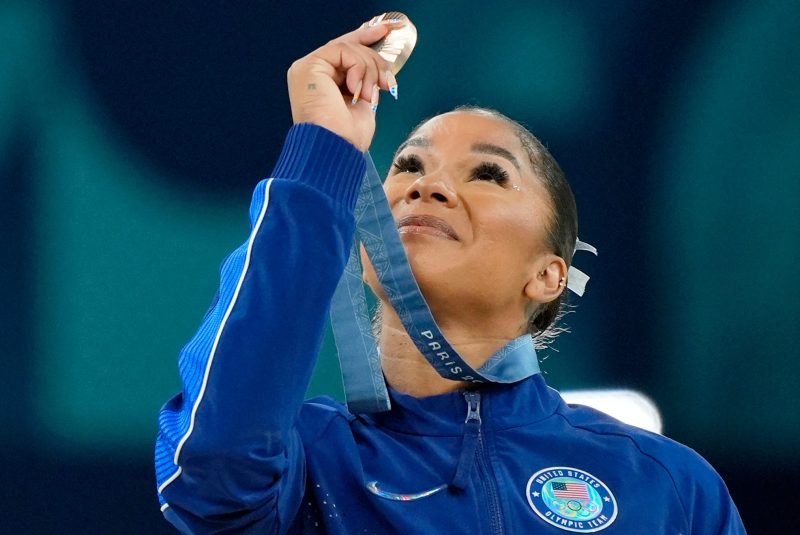
Jordan Chiles is one step closer to keeping her Olympic bronze medal.
The highest court in Switzerland handed Chiles a key legal victory, announcing Thursday, Jan. 29, that it had granted part of her appeal and was kicking her case back to the Court of Arbitration for Sport for reconsideration. It cited video that shows Chiles’ coach making an inquiry over her score within the allotted time.
‘In the highly exceptional circumstances of the case in question, it considers that there is a likelihood for the audio-visual recording of the final on 5 August 2024 to lead to a modification of the contested award in favour of the applicants, since the CAS could consider, in the light of this audio-visual sequence, that the verbal inquiry made on behalf of Jordan Chiles had been made before the expiry of the regulatory one-minute time limit,’ the Swiss Federal Tribunal said in a statement announcing the decision, which was issued Jan. 23.
The tribunal rejected Chiles’ appeal over the independence of the head of the arbitration panel, who had done work for the Romanian government. It also rejected the appeal by a Romanian gymnast of an out-of-bounds decision, saying it was not reviewable.
Jordan Chiles’ attorney: ‘Righted a wrong’
Maurice Suh, the U.S.-based attorney for Chiles, said the gymnast appreciates the opportunity for a new hearing and will fight ‘vigorously’ to keep her medal.
‘We are delighted that the Swiss Federal Supreme Court has righted a wrong and given Jordan the chance she deserves to reclaim her bronze medal,’ Suh said in a statement. ‘As the Court recognized, there is ‘conclusive’ video evidence that Jordan was the rightful winner of the bronze medal.
‘We also appreciate the Court’s recognition that ‘extraordinary time pressure’ and notification defects prevented Jordan from presenting this important evidence in August 2024,’ Suh added. ‘We appreciate that Jordan will receive a full and fair opportunity to defend her bronze medal.’
USA Gymnastics supports Chiles
USA Gymnastics, which had submitted evidence and statements on Chiles’ behalf through the appeals process, said it looks forward to the gymnast getting a ‘fair’ hearing.
‘We are pleased the Swiss Federal Supreme Court recognized the flaws in the initial process and that Jordan’s case can now be heard inclusive of all relevant evidence,’ the federation said in a statement. ‘We look forward to a fair arbitration that includes the clear evidence proving the inquiry into Jordan’s score was filed well within 1 minute as required by FIG rules.’
USOPC praises Childs
The U.S. Olympic and Paralympic Committee echoed Suh and USA Gymnastics’ appreciation for the Swiss tribunal recognizing that Chiles wasn’t given a full opportunity to defend herself.
It also praised the gymnast, who was subjected to vicious and racist attacks online in the days after competition.
‘Jordan has handled this movement with strenghth and professionalism, and we remain firmly behind her as she continues to pursue the result she earned,’ the USOPC said in a statement.
No date for new CAS hearing yet
It’s not clear when CAS will hold a new hearing, with a spokesperson saying it was ‘too soon’ to know a date.
But CAS did say in a statement that it accepted the tribunal’s ruling that the video evidence ‘justifies’ a new hearing.
‘Following the SFT decision, CAS can now ensure a thorough judicial review of the new evidence that has since been made available,’ CAS said in its statement.
Case has dragged on for 18 months
The ruling brings Chiles closer to resolving the messy, error-filled dispute that initially resulted in the American being stripped of her bronze medal from the floor exercise on the last day of the Paris Olympics.
The Romanian Gymnastics Federation had claimed that Chiles’ scoring inquiry had been filed too late, but video footage discovered after CAS’ initial ruling shows that her coach, Cecile Landi, had made the inquiry well within the 60 seconds allowed. CAS declined to reconsider its decision upon receiving the video, which prompted Chiles, USA Gymnastics and the U.S. Olympic and Paralympic Committee to take the matter to the Swiss Federal Tribunal.
Following the Swiss court’s decision, the final order of finish on the floor exercise will once again be in the hands of CAS.
Timing of inquiry key to case
The decision to strip Chiles’ of her medal caused an international furor that overshadowed the end of the Games, in large part because it involved a dispute over the minutiae of gymnastics rules rather than any mistake or wrongdoing by Chiles − or, for that matter, any of the other gymnasts involved.
Unlike other cases of medal reallocation, which often follow doping or cheating violations, this case hinged on an apparent error by officials with the International Gymnastics Federation (FIG), which oversees the sport.
Chiles initially finished fifth in the floor exercise final on Aug. 5 with a score of 13.666, leaving her behind Romanian gymnasts Ana Barbosu and Sabrina Maneca-Voinea. (The pair had each scored 13.7, but Barbosu has placed higher because of a better execution score.)
But Landi, who was Chiles’ personal coach in addition to being the U.S. coach in Paris, appealed her difficulty score, arguing Chiles had not been given full credit for a leap called a tour jete. A review panel on site agreed, and the additional 0.100 elevated the American ahead of both Romanians into third place. Romania then appealed to CAS the next day, challenging the timing of Chiles’ appeal.
Data from Omega, the official timing system, showed Chiles’ inquiry had been registered four seconds too late, and CAS used that as the basis for its first decision. But Chiles’ lawyers have pointed out that the verbal inquiry would have had to have been made at least a few seconds before an official entered it into the timing system. The FIG acknowledged during the CAS hearing that it had not put safeguards in place so officials would immediately know whether verbal appeals were submitted on time or late.
USA Gymnastics said on Aug. 11, 2024, the day after the first CAS ruling, that it had obtained footage showing Landi made the first verbal inquiry 47 seconds, within the 60 seconds allotted. But CAS said it could not accept evidence after the fact.
Though CAS ordered the FIG to re-order the results to what they were before Chiles’ appeal, it blasted the federation, both for its ineptitude and the grief Chiles and the Romanians endured.
‘If the Panel had been in a position to apply equitable principles, it would surely have attributed a bronze medal to all three gymnasts in view of their performance, good faith and the injustice and pain to which they have been subjected,’ according to the CAS decision, released Aug. 14.
‘The Panel expresses the hope that the FIG will draw the consequences of this case, in relation to these three extraordinary Athletes and also for other Athletes and their supporting personnel, in the future, so that this never happens again.’
The IOC accepted the re-ordered results and said Chiles’ medal should be reallocated. Romania then awarded Barbosu a bronze medal Aug. 16.
That was never going to be the end of it, however. The Americans had vowed to pursue the case all the way to the Swiss Federal Tribunal on behalf of Chiles, knowing she and Landi had not done anything wrong.
Notification errors were CAS’ fault
In addition to their evidence showing the inquiry had been submitted in time, and the unfairness for punishing Chiles for the FIG’s error, the Americans cited process errors by CAS. They argued that the arbitration panel had sent emails to the wrong parties for three days after Romania had filed its appeal. That meant Chiles and U.S. officials had less than 24 hours to read all the documents in the case, analyze them, craft a response and prepare for the hearing.
In its statement, Suh’s office said the Swiss Federal Tribunal recognized that ‘extraordinary time pressure’ was a factor in why Chiles didn’t submit the video evidence at the hearing. The tribunal decided those notification errors were CAS’ fault, Suh’s office said, and “caused an imbalance between the parties’ in the case.