
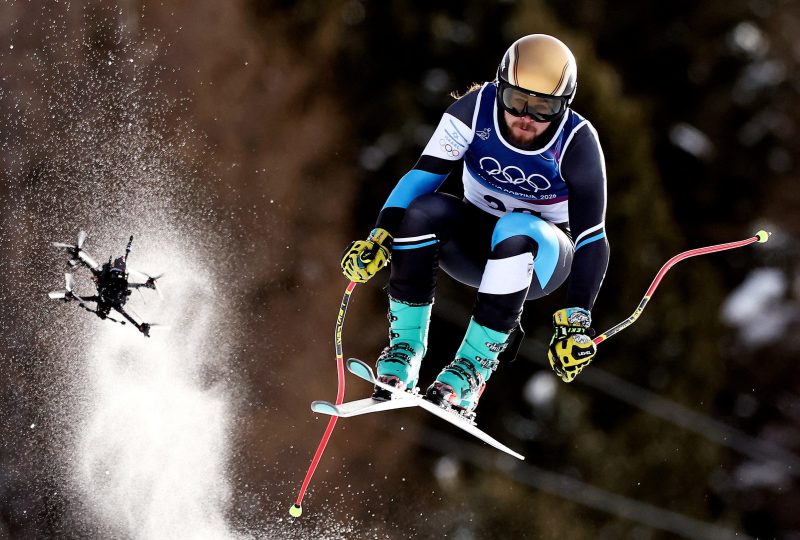
The 2026 Winter Olympics have already delivered incredible feats of athleticism and the raw emotions that help this global sporting competition transcend sports and become part of the human condition. It’s the new camera angles showing these Olympic moments, however, that might be the biggest innovation to come out of the first week of the Milano Cortina Games.
Drone cameras have been used at the Olympics before, but new technology is allowing first-person view drones to bring viewers closer to the action than ever before, particularly in winter events like the luge, skiing and snowboarding. This new level of detail has also come with some concerns, though it appears the dynamic views produced thus far are worth the potential problems.
‘We look at this as an evolution of the sport. The expectation today is to have this kind of experience when you consume a sports event, even more so for the Olympic Games,’ IOC sports director Pierre Ducrey told Reuters earlier this week. ‘We strive to offer the best viewing experience whether in the stadium or outside.’
Here’s more on the drone cameras that are all the rage at the 2026 Winter Olympics:
2026 Winter Olympics drone cameras, explained
Drone cameras have been used at the Olympics dating back at least a decade, but the development of first-person view drones has been deemed ‘a game changer’ for the viewing experience by NBC officials, especially in speed sports.
These FPV drones can cover great distances and safely travel up to 75 mph while maintaining broadcast quality. They’ve also been used to provide aerial coverage as athletes move at high speeds. They weigh just 250 grams (or less than one pound), according to one Olympics drone operator featured in an NBC social media video.
Each drone is operated by a three-person team – a pilot, a director and a technician – that manage the camera’s flight path, according to The Washington Post. The drone can go close to an athlete, but not over them. Each drone has a broadcast camera and broadcast transmitter attached to it.
‘When a camera is chasing the athlete down the hill – right in front of them or right behind them – you truly get the sense of how fast they’re going,’ Michael Sheehan, the coordinating director for NBC’s Olympic coverage, told The Washington Post. ‘That’s virtually impossible to capture with a wide shot shooting from the side. The drone coverage takes us to a place we’ve traditionally never been.’
Why 2026 Winter Olympics drone cameras can be controversial
Though the dynamic camera angles created by FPV drones is giving fans a view of the Winter Olympics they’ve never seen before, it does comes with some potential drawbacks.
Most notably, the high-pitched whirring noise created by drones has been audible during broadcasts and it’s ever-present for spectators attending outdoor events in which a drone camera is being utilized. It has led to social media complaints akin to the vuvuzela controversy at the 2010 World Cup.
Some athletes have also expressed concerns about how close these drones get to them while competing. So far, however, this hasn’t created major problems. The BBC reported one of the drones crash-landed in the first downhill skiing training session and left debris on the course.
‘We tested drones before competitions, we have listened to the athletes’ community … so that the impact would not affect their performances, would not bother them in any way,’ Milano Cortina Olympics Sports Director Anna Riccardi told Reuters.
‘Each athlete has a different level of sensitivity, awareness and capability for tackling innovation,’ she added. ‘So far we have not received any complaints that might lead to the non-use of drones in the future.’