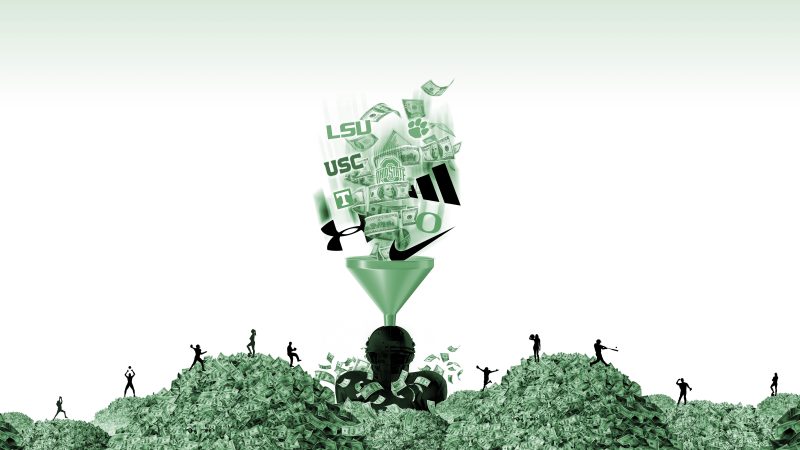
Colleges and apparel companies are now including Name, Image, and Likeness (NIL) money in their partnership contracts.
These NIL provisions allow schools to legally facilitate more compensation for athletes beyond the new NCAA revenue-sharing cap.
This trend is primarily seen with Power Four conference schools, increasing the financial gap between them and smaller universities.
While this practice is currently allowed, it faces scrutiny from the College Sports Commission, which oversees third-party NIL deals.
When the University of Tennessee athletic department switched its apparel provider from Nike back to Adidas last summer, the biggest clue as to why was hidden within a sentence seven paragraphs into the university’s announcement.
Lucrative outfitter contracts between big-name sports apparel companies and college athletic departments are nothing new. Universities get discounts on product and the cachet of being associated with blue-chip brands; brands get to see their logos on television and build relationships with generations of loyal fans.
In college athletics’ name, image and likeness (NIL) era, these symbiotic relationships have a new twist: Power conference NCAA schools and apparel providers are negotiating contracts to include money earmarked for NIL, allowing schools to legally facilitate endorsement deals for athletes without exceeding revenue share limits.
“The scope of what these relationships look like has changed,” said Chris McGuire, Adidas vice president of sports marketing for North America. “Initially, ‘the arms race,’ was all about facilities and how could the financing from apparel deals help them build better facilities to attract the recruits.”
Now, it’s about who can inject cash into NIL to secure more above-the-cap dollars for a program’s athletes.
Inside college apparel deals, NIL and the NCAA revenue cap
The House vs. NCAA settlement led to direct revenue sharing between colleges and athletes effective July 1, 2025. For the 2025-26 academic year, each school can distribute a maximum of $20.5 million – the “cap” – to its athletes. But there is no limit to how much NIL money college athletes can receive from third parties such as apparel companies, so long as deals are approved by the College Sports Commission.
Brands like Nike, Adidas and Under Armour pay tens of millions of dollars to outfit SEC and Big Ten teams through partnerships that often last up to a decade. Building NIL provisions into those deals gives schools a method to increase total athlete compensation and gives brands a direct line to college athletes they were likely to target for endorsement deals anyway.
Adidas isn’t the only company helping schools get creative. LSU’s extension with Nike this summer was announced in tandem with news of 10 LSU athletes signed to Nike’s new NIL collective. Wisconsin inked a new deal with Under Armour that includes an NIL commitment.
Pat Flynn, a former Under Armour and Learfield employee and founder of College Athletics Management, a company that consults with athletic departments and brands, predicted that this practice will become the new normal.
“NIL has pumped new life into apparel deals,” Flynn said. “The apparel companies are getting smarter in the fact that, OK, now schools need us to help on the NIL side a lot more than all the apparel and cash we had to provide (to athletic departments) in the past. We can really serve a true purpose with NIL.”
College apparel contracts negotiated on an uneven playing field
The revenue-sharing settlement’s timing was serendipitous because it happened when multiple power-conference schools have expiring apparel contracts.
Tennessee, Penn State and South Carolina are among the schools that agreed to switch apparel providers in 2026, while LSU and Wisconsin signed extensions. Louisville, Michigan, Texas A&M and UCLA are among schools with apparel contracts set to expire in 2027 or 2028.
Schools can leverage an expiring apparel deal into NIL funding, and brands are likewise using NIL to get a leg up at the negotiating table.
“It’s a lever that can be pulled in the negotiation by both sides,” said consultant Dan Gale, president of Leona.
When it comes to how the NIL components are structured, however, it’s not one-size-fits-all.
In its recent 10-year contract renewal with Wisconsin, Under Armour pledged no less than $175,000 in each year of the contract to NIL. At LSU, Nike launched a new NIL collective called Blue Ribbon Elite featuring Tiger athletes and plans to expand the program to other universities.
Adidas, in addition to allotting money to Tennessee for NIL deals with a select number of athletes, offers athletes at any Adidas-affiliated school to join its ambassador program and receive a commission for promoting the company’s products.
The financial details of some apparel agreements – including those at Tennessee and LSU – are unknown because they are run through separate, nonprofit university foundations, which allows the contracts to remain private and unobtainable via public records request.
Sometimes, even if an apparel agreement doesn’t specifically call for an NIL commitment, it can set the stage for related endeavors. That’s what happened in 2024 at Texas Tech, where the university signed a 10-year contract with Adidas weeks before the company teamed up with NFL quarterback Patrick Mahomes to create an NIL collective for Texas Tech athletes.
This February, Texas Tech athletic director Kirby Hocutt told program stakeholders that the Red Raiders plan to ask Adidas and other corporate sponsors to redirect money to athlete NIL deals that was initially intended for the athletic department.
“I would say (NIL) is definitely a focus as we move forward with all our university partners,” McGuire said. “It is a centerpiece of both our relationships with Tennessee and Penn State, and since we’ve expanded that to really include just about all our major universities that are participating in the Power Four.”
Non-power conference schools so far have been largely excluded from this trend because of how they execute apparel deals. Smaller schools often contract with regional suppliers such as BSN or Game One, which act as wholesale distributors for Nike and other apparel giants.
That means larger schools have the advantage in negotiating extra benefits including NIL dollars, so the chasm between the top and middle tiers of athletic departments keeps widening.
“It’s very rare right now to have any NIL cash unless you are a direct school without any third-party service provider,” Flynn said. “There’s probably 20 schools right now, maybe 25, that are direct from the brand to the school.”
From a brand perspective, a Conference USA school has less NIL value than an ACC school. So even if a smaller university contracts directly with a brand, the deal usually takes the form of a purchasing agreement rather than a marketing agreement.
Additionally, not every university prioritizes NIL dollars in apparel contracts. Ohio State, which reported operating revenues of more than $330 million in 2025, is probably more inclined to look at apparel contracts from a revenue-share perspective compared to a school like Kent State, which the same year reported $32 million in operating revenue.
Gale said that non-power conference athletic departments are less concerned with skirting the revenue share cap and more concerned with their bottom line.
“That level is about trying to save net impact on your department,” Gale said. “So each school has to look at their apparel deal a little differently. It’s not just a blanket industry thing, but the industry is really focusing on the top tier. And the rest are trying to maximize their value.”
Is putting NIL money in apparel contracts allowed?
Although writing NIL commitments into apparel contracts is currently allowable under both federal law and NCAA guidelines, it’s less clear if the burgeoning loophole will be subject to much oversight.
The College Sports Commission (CSC) is the enforcement body responsible for reviewing all deals made between NCAA Division 1 athletes and third parties. As part of the House settlement, athletes must submit deals worth more than $600 to a portal called NIL Go, created by Deloitte, and the CSC determines whether it was made for a valid business purpose and reasonable compensation.
In January, the CSC sent a letter to schools warning of “serious concerns” with some third-party NIL deals. The organization said that all agreements offered by an associated entity – including apparel and multimedia rights partners – must specify how the athlete’s NIL rights will be used.
“Making promises of third-party NIL money now and figuring out how to honor those promises later leaves student-athletes vulnerable to deals not being cleared, promises not being able to be kept, and eligibility being placed at risk,” the letter said.
The CSC does not review university apparel contracts as part of its standard process. Neither does the NCAA, a spokesperson confirmed.
When there is an NIL component in an apparel deal, schools must tread lightly when touting it during the recruiting process. According to NCAA and CSC rules, schools are allowed to outline how much they’ll pay a player directly – coming out of the revenue sharing cap – but are not allowed to promise third-party NIL money. Schools can connect athletes to third parties.
A brand that guarantees NIL money to a school through an apparel contract would still have to negotiate endorsement deals directly with athletes, who are then required to report details of deals exceeding the $600 aggregate threshold. During the review process, the CSC may ask for the apparel contract to see if the university qualifies as an associated entity – and even if it does, the deal still wouldn’t count against the revenue sharing cap.
Ahead of Adidas’ new deal with Tennessee kicking in this summer, the company is already working to secure NIL deals with Vol athletes. McGuire said Adidas will “compare notes” with coaches and their staffs to come up with a list of athletes for potential endorsement deals.
“How can we partner with them to assure that as they look at the talent needed for their rosters, we’re right there with them?” McGuire said. “And it reciprocates, right, because these are all tremendous athletes that we want to be associated with our brand.”