
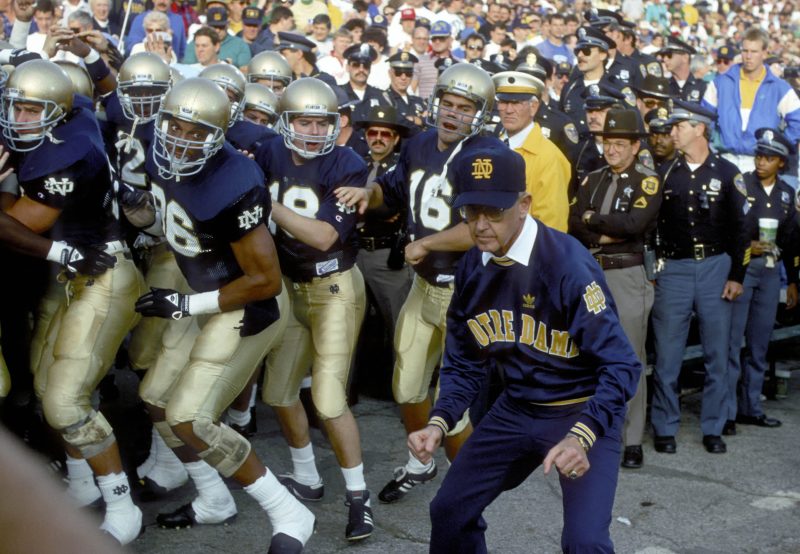
Pull up a chair, and take a load off, everyone. And soak in the world around you.
Forget about football or winning and losing, or championships and near-misses. That’s the very last thing Lou Holtz would’ve wanted any celebration of life to include.
Not that football wasn’t part of Holtz’s story, but that his life story — the last chapter finally played out Wednesday, March 4, after 89 full years — was so much more than that. This is about life and love, and finding the very best of who and what you are.
If that included the football field, great. But it wasn’t the message Holtz delivered over and over, through decades of coaching football and years on the speaker circuit.
This is the Gospel of Lou.
“Everybody wants to win. I always used to ask my players, ‘Can you live with losing? Can you live with failure?’ That’s life’s motivator.”
Years ago when I lived in Orlando, I went to see Holtz speak to the Orlando Touchdown Club, a lively group of a couple of hundred that used to meet at the old Citrus Bowl Stadium before it was rehabbed a couple of times.
I still have the notebook from that day, because by the time Holtz finished speaking, it was clear why he was paid thousands all over the country to spread the gospel. It was more than motivation, Holtz had the rare ability to make you think ― long after hearing him speak.
See Lou Holtz commemorative section
Every speech hit the same talking points, each tweaked to fit the audience, the locale, the moment.
From the billion dollar Ford Motor Company in Dearborn, Mich, to the folksy yet fiery Little Rock Touchdown Club, to all of those companies and clubs between, Holtz spread the message. He used football analogies to underscore the points he was making.
It wasn’t about Notre Dame or South Carolina or Arkansas or the New York Jets, it was about being the best you. And how every day is a chance to change.
“If you’re bored with life, you haven’t set your goals high enough.”
He’s the only coach in NCAA history to lead six schools to bowl games, back when bowl games actually meant something. When he retired from Notre Dame and walked off the field in South Bend for the last time in November of 1996, he did so specifically knowing he was six wins shy of setting the school record for victories.
He could’ve stayed at least another year and set the record (later broken by Brian Kelly), but said there was only one greatest ever coach at Notre Dame. And who was he to win more games than Knute Rockne?
He loved stalking the sidelines, lived for beating USC. He cherished those early Saturday morning prayers at the Grotto, and the Concert on the Steps at Bond Hall — before he and his team even stepped on the grass at Notre Dame Stadium.
He was quick to point out every game was played amid the loving, open arms of Touchdown Jesus, and the 4,000-pound gold statue of the Virgin Mary on top of the tallest building on campus. Or as Holtz called her, the Lady on the Dome.
These were rare life experiences, and if you aren’t chasing life’s thrills every day, what exactly are you doing?
“Are you committed, or are you the kamikaze pilot who flew 42 missions?”
Holtz was always committed to teaching and preaching, and the facilitator was football. Maybe that’s why he only stayed away from the game for two years after leaving Notre Dame.
He took a job with the ragtag program at South Carolina, and didn’t win a game in his first season. He then won 17 games over the next two seasons, and finished each with a victory in the Outback Bowl.
But it eventually fell apart over the next three seasons, ending in 2004 with what Holtz routinely described as his biggest professional disappointment: a brawl after the rivalry game with Clemson.
He never coached again. Football, anyway.
“No one has ever drowned in sweat.”
He won 249 games as a college coach, and three lousy games in one season with the NFL. When he quit his job with the Jets with one game remaining in the 1976 season, Holtz declared, “God did not put me on this earth to coach professional football.”
More likely, God put Lou Holtz on the earth to preach.
When he spoke, his unique voice and delivery — and the escalating, booming sound of his voice, despite his lisp, driving home point after point — had every person in every room on the edge of their seat.
Not unlike the way he motivated his players, typically poor-mouthing them in public while winding them up privately. Before maybe the biggest game of his Notre Dame coaching career, when loaded Miami came to South Bend in 1988 and the pre-game devolved into Catholics vs. Convicts, Holtz got his team zeroed in like only he could.
He spoke about the Canes and the bombastic bravado of their players and coach Jimmy Johnson, and how this Notre Dame team would take it all from them. Then right on cue — his voice rising to that unique crescendo — he said, “But save Jimmy Johnson’s ass for me!”
The Irish then went out and beat the Canes 31-30.
“It’s not the load that breaks you, it’s the way you carry it.”
Holtz often spoke of his time at Arkansas, where his first team in 1977 famously won the Orange Bowl over 18-point favorite Oklahoma — despite Holtz suspending three starters days before the game after an incident at their dorm.
Holtz used to speak of driving to work in Fayetteville, and how every day he’d cruise by a cemetery. The enormity of the moment was never lost.
“I thank god I have the opportunity to solve my problems. We tend to look at how bad things are instead of picking up ourselves up and embracing the wonderful opportunities we have.”
And that, everyone, is the Gospel of Lou.