
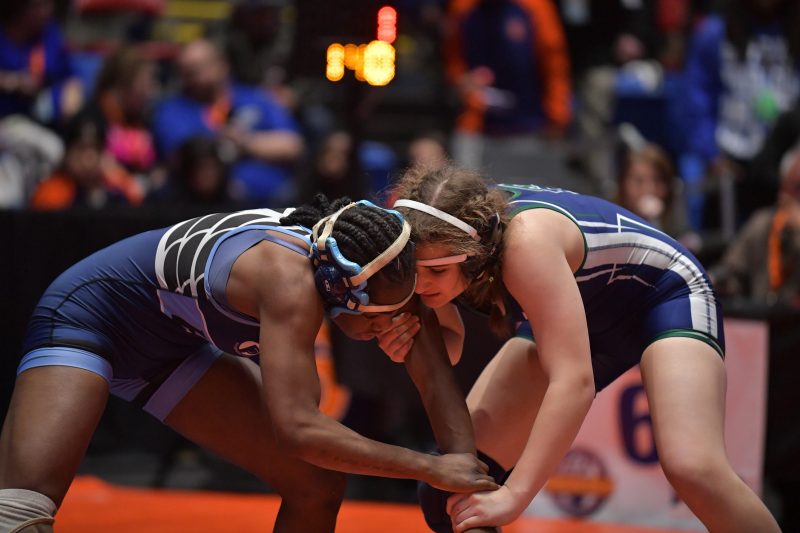
This is Part 1 of a two-part series examining girls wrestling, one of the fastest growing sports for high schoolers. We spoke with the Giller family, who successfully navigated equal high school access for their daughter in Illinois, and Karissa Niehoff, chief executive officer at the National Federation of State High School Associations (NFHS), about how you can ensure your child has it, too.
Jillian Giller started wrestling in seventh grade. She took to it immediately, her parents say.
“It’s one of the last sports,” says her mother, Jenifer, “particularly in the more competitive area, where you don’t need to start when you’re 6 in the community league, and there’s still an opportunity.”
Giller and her husband, Scott, a former high school and collegiate wrestler, made sure their daughter had the platform and opportunities to excel at it.
But when she reached her public high school in suburban Chicago, there wasn’t a girls team. She became the only girl on an all-male freshman team.
Jillian’s parents weren’t sure other girls at school knew they could be wrestling, too. The Illinois High School Association had just sanctioned girls wrestling as a sport for that 2021-2022 school year.
Eventually, as Jillian advanced grades, the school formed a girls team, but the optics screamed of inequity.
“They told the girls they couldn’t have more warmups,” Scott says, “(that) they only had enough for the boys. That’s like a real thing that happened.”
He and his wife looked at the programs at other schools – their schedules and equipment, among other details – and came up with a plan. Over about 15 months, they say, they spent hundreds of hours of research and writing and meeting with people they thought could help them, including the school’s athletic director, principal and Title IX coordinator, and the president and vice president of the school board.
“You always think you’re gonna find an adult in the room and we just never did,” Scott tells USA TODAY Sports. “All they did was keep affirming what their people were saying.”
The family’s complaint, which wound up in the Department of Education’s Office of Civil Rights, eventually yielded the equal resources they wanted.
Their prolonged struggle highlights recent cases – in their state and in other parts of the country – where wrestlers and parents feel schools are violating Title IX protections.
“Our schools do a good job and our state associations do a good job of keeping Title IX in the forefront,” says NFHS CEO Karissa Niehoff, who wasn’t familiar with the Giller’s case. “I think if there’s anything to point to, it would be, if we have separate facilities or access to facilities, what does the differential look like?
“But in terms of programming, we have really not heard from around the country about a glaring issue. I do think the issues are out there and it may be an educational issue. Do schools and districts understand what Title IX means? If they don’t, they should.”
We spoke with Scott and Jenifer Giller, whose story eventually helped lead their daughter’s high school to establishing what they call a “best-in-class” girls wrestling program, and with Niehoff, a former Division 1 athlete and high school coach and administrator before she joined the NFHS. They spoke as resources for families seeking equal access for their daughters through high school sports.
What is Title IX and how is girls high school wrestling protected under it?
Title IX, which passed in 1972, is a civil rights law that requires equity across a wide range of areas in academics and athletics and bans sex discrimination against students, employees and others at public schools, colleges and universities that receive federal funding.
As it pertains to high school athletes, it requires schools to offer equal athletic opportunities for boys and girls in such areas as facilities, scheduling, competent coaching and publicity.
Over 25 years, through the help of Title IX, girls high school wrestling has grown from under 2,500 participants to more than 74,000, according to the 2024-25 NFHS survey.
Forty-seven state high school associations (including Washington, D.C., which has its own association) are holding official state championships for girls wrestling this school year.
This weekend, numerous wrestling state championships are being held across the country, including in California, a state where more than 8,800 high school girls compete.
“It continues to grow,” says Ron Nocetti, the executive director of the California Interscholastic Federation. California’s participation has risen by 3,500 wrestlers and nearly 100 schools participating in girls wrestling since 2018.
“I think our school districts do an excellent job in handling matters when a parent does bring a concern to them,” Nocetti says. “If there are concerns our schools and school districts work extremely well together to resolve any complaints that are offered. I think their goal is to avoid those to begin with and provide the opportunity for girls that want to participate in wrestling to be able to do so.”
Niehoff, the NFHS CEO, says the spirit of Title IX underscores not just dollar-to-dollar funding, but access and opportunities: the number of athletic programs offered, funding and facilities that support programs appropriately and even attention in school media like the athletic handbook.
“Do we talk about our boys and our girls’ programs equally?” Niehoff says. “Do we fund the coaching needs? Do we provide coach education? Do we provide access to celebratory nights? You have a boys football Friday night, guys wearing the jerseys in the hallways; do we celebrate the girls in the same way? So I think a lot of context around Title IX is important.
“The biggest area that we have discussed over the last few years is really facilities based, not program based. So, for example, the baseball fields for boys could have really nice dugouts and lights and such, whereas the girls softball fields don’t have those things.”
How can you determined if you have a Title IX argument against your school’s athletics department?
Complaints and issues with equal opportunity and access in girls wrestling have arisen at other schools in suburban Chicago. There are documented cases in Oregon and Tennessee where Title IX lawsuits have been filed citing, among other allegations, unequal training space for boys and girls wrestlers and mistreatment of the girls team by a male coach.
“We were always in the corner, always pushed aside, and I don’t think that’s a good role model for a head coach, especially for your female athletes who are in a very male-dominated space,” said Cleveland (Oregon) High senior Kiera Callahan, according to a December 2025 story on Fox 12 Oregon’s website.
During Jillian Giller’s freshman year of high school, her parents say, she was offered either a boys singlet or basketball rash guard and shorts for her uniform. The next season, when the team added two more girls wrestlers, they spoke to the school about adding more than three tournaments (far fewer than the boys team had scheduled).
(The Gillers requested USA TODAY Sports not mention the name of Jillian’s high school to prevent reopening an issue that has been resolved.)
The first step in the process, they said, was making the formal ask. But before they did that, they looked around at how other schools in their area were constructing girls wrestling programs.
They had branded girls-cut singlets, a full schedule of tournaments (the Gillers collected about a half-dozen schedules to prove what the schools were doing) and a dedicated girls coach, not whichever coach was available or free from the boys team.
The Gillers said their school fixed a lot of the optics. It provided the girls with warm-up gear the day after Scott mentioned them to the principal, and branded singlets the following week.
“I think one of the real struggles with this sport is that there is a perception among people who don’t know wrestling well that girls wrestling is still an up-and-coming sport,” Jennifer Giller says. “That’s kind of how our complaint was treated when we went through the school was that, ‘Well, you know, it’s a new sport,’ and it almost suggested the lack of opportunity within the sport when that’s just not the case.”
If you are facing perceived Title IX inequality, what steps can you take?
Niehoff suggests starting with your school, where you’ll need evidence that there’s a Title IX issue.
“If you have a handful of kids that want to play something, to go say, ‘You should sanction this,’ is not appropriate,” she says.
High schools aren’t mandated to have a girls wrestling program. But if you can prove there is wider interest than just a few girls, you can better make your case. Niehoff said most states provide opportunities to co-op with other schools to have a combined program.
Once a program is established, Title IX runs much deeper than what we see in girls enrollment numbers and how teams present themselves in public. Its essence lies in how we treat one another.
“We have to pay attention if you have boys and girls wrestling program then, just like basketball, if you schedule the boys for 2 ½ hours in the gym, then give (it to) the girls,” Niehoff says. “If you have the wrestling mats down, practice for two hours or what have you, the girls should get the same time. And the cleanliness of the wrestling match is a big deal. So I would say maybe you flip flop, some days the boys go first, some days the girls go first. You clean the mats in between, because wrestling is a huge health issue, skin issue.
“So I think equity in time and access is huge, making sure the facilities are clean and time access is fair and equal. But if the boys are getting new uniforms every year, then the girls should. It’s practice that really is the focus.”
In the Gillers’ case, as the girls program started to emerge at Jillian’s school, they saw a pattern of alienation and harassment from coaches toward their daughter. Scott first emailed then spoke directly with the coach. After the conversation, the Gillers filed a complaint with the school’s Title IX coordinator.
Their complaint, they say, triggered an internal investigation that revealed a lack of transparency on the issue from the school.
“I didn’t want to be that dad,” Scott Giller says. “I didn’t want to be a guy going (against the) world, and, like, no one was doing it and it just seemed unreasonable. And I think it took a lot of time because we wanted to make sure what we were asking for was reasonable. We didn’t know what that was, until we started digging into (everything).”
They found their main resource for understanding their rights under Title IX came through the Office of Civil Rights’ website. The most helpful section was one that detailed Title IX criteria around athletics.
It’s general statement for athletics: No person shall, on the basis of sex, be excluded from participation in, be denied the benefits of, be treated differently from another person or otherwise be discriminated against in any interscholastic, intercollegiate, club or intramural athletics offered by a recipient, and no recipient shall provide any such athletics separately on such basis.
‘Try and be reasonable’ with your Title IX-related request
The Gillers say they decided to file their complaint through the Office of Civil Rights only after their school and school board channels were exhausted.
“I think what was great about raising awareness locally and what was at least in part responsible for moving that needle was it made it harder to say, ‘Well, there’s less for girls because less exists for girls,’ ‘ Jenifer Giller says. ‘Like the reality (behind) fighting for more was there was so much out there for the girls to participate in.”
She and her husband documented the pattern of harassment of their daughter in writing. They said preserving text messages, emails, photos helped make their case.
“I think the best way to start is, (with the athletic director and/or principal) try to work it out and be reasonable,” Scott says. “Know what you’re trying to accomplish. You want more matches, you want equal equipment, you want a coach but I think you could work a lot of that out optically without causing a lot of problems.”
Scott and Jenifer said, due to legal constraints, they can’t share details on their work with the Office of Civil Rights. But they said their goal from the beginning – when they sat down with school administrators in early 2023 – was a girls wrestling program that provides resources, opportunities and treatment comparable to what the boys receive. They say that was the end result.
By her senior year, Jillian’s girls high school team had 12 or 13 wrestlers and two coaches. She’s now a freshman on the women’s wrestling team at Illinois Wesleyan University.
“We’re seeing every year there are more collegiate programs and with that comes opportunity for girls who might not even realize that the opportunity to wrestle exists,” Jenifer Giller says. “So it’s hard to see that opportunity pass girls by because the schools aren’t willing to commit the resources that they’re technically supposed to under Title IX.
“I think these are girls who might not have ever excelled in another sport, but can really excel at wrestling.”
Part II coming Sunday: Checking in on California, which is No. 1 among states in girls wrestling participation.
Borelli, aka Coach Steve, has been an editor and writer with USA TODAY since 1999. He spent 10 years coaching his two sons’ baseball and basketball teams. He and his wife, Colleen, are now sports parents for two high schoolers. His Coach Steve column is posted weekly. For his past columns, click here.