
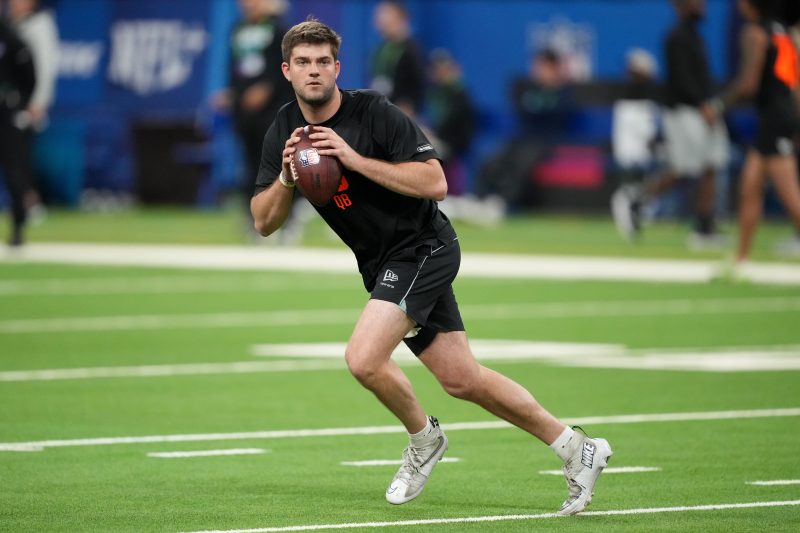
The 2026 NFL Draft’s quarterback class had a key opportunity to prove itself at the NFL Scouting Combine.
Indiana’s Fernando Mendoza – the draft’s presumptive No. 1 overall pick – chose not to work out with his status as the class’ top overall quarterback secured. That gave 14 signal-callers a chance to stake their claim as the second-best quarterback on the board.
Several took advantage of the opportunity. Ty Simpson starred and likely cemented his first-round status, while Garrett Nussmeier and Carson Beck stated their cases to be Day 2 picks in the 2026 NFL Draft.
How did all the quarterbacks at the 2026 NFL Scouting Combine fare? Below are USA TODAY Sports’ grades for all of the passers who worked out in Indianapolis.
2026 NFL combine: Top quarterback grades, rankings
1. Ty Simpson, Alabama: A
Simpson was the clear-cut best quarterback on the field at the NFL combine. The Alabama product was near-perfect in on-field drills, displaying smooth mechanics and elite ball placement and accuracy at all three levels of the field throughout the session.
It was hard to find many – if any – mistakes in Simpson’s workout and his performance in the deep-passing drills was impressive. His performance should cement him as the No. 2 overall quarterback in the 2026 NFL Draft class and will help to solidify his first-round status.
2. Garrett Nussmeier, LSU: B+
Nussmeier didn’t get off to the best start in his throwing session. His ball placement was slightly off as he settled in, which caused some of the receivers to whom he was throwing to have to make off-frame catches.
After the minor, early-workout jitters, Nussmeier settled in nicely. He demonstrated good accuracy and timing throughout the latter portion of the workout and showed polished mechanics and footwork on his downfield throws. Most importantly, he looked healthy after dealing with a troublesome oblique injury that impacted him in his final season at LSU.
3. Carson Beck, Miami (FL): B+
Indiana fans at the NFL combine were booing Beck every single time he stepped up to throw. That didn’t stop Beck from putting on the best performance of the first throwing group in Indianapolis.
The Miami product was on target with many of his throws at all three levels of the field with good timing on breaking routes from the receiving prospects. His footwork and mechanics were also solid. Beck made a few throws he’d probably like to have back, including a couple of misfires on deep passes, but he remained consistent in a harsher environment than what the other QBs experienced.
4. Cade Klubnik, Clemson: B
Klubnik acknowledged coming into the combine his superpower was his accuracy. He put that on display at the combine, routinely feathering passes to his receivers, particularly to the deep and intermediate portions of the field.
The only bummer about Klubnik’s combine was that the dual-threat quarterback opted not to run the 40-yard dash. Nonetheless, his workout – and the steadiness he showed with his footwork – should provide a boost to his draft stock.
5. Drew Allar, Penn State: B
Allar seemingly had the best raw tools of the passers in his earlier group. He showed the most consistency on deep passes, including a couple of beautiful throws on a straight ‘go’ route and a ‘corner’ route. He also had some of the best timing on throws to breaking routes.
The biggest question mark for Allar is his rawness. While the tools are all there, the Penn State product still needs some refinement. His footwork during the quarterback throwing drills was messy and inconsistent, and his mechanics showed a tendency for over-reliance on his arm without marrying his upper and lower halves.
6. Jalon Daniels, Kansas: B-
Daniels was one of the clear winners from the opening throwing session at the combine. The Kansas product showed off his arm talent with a couple of beautiful deep passes and some zip on shorter throws.
The biggest knock against Daniels was his inconsistency. While some of his throws were among the best of the group, particularly his second deep pass, there were some questionable misses on easier attempts. Regardless, Daniels quietly may have made himself some money by showing off what his arm can do when he stretches out for deep throws.
7. Diego Pavia, Vanderbilt: B-
For any other quarterback, measuring in a 5-10 1/8 would be problematic. But after Pavia measured in at just 5-9 7/8 at the Senior Bowl, the 1/4-inch improvement was critical in helping the Vanderbilt quarterback avoid becoming a historic outlier at the position.
Pavia then showed well in the on-field drills, displaying very good accuracy throughout the session. The Heisman Trophy runner-up was not as flashy as he would be in game action – which was to be expected – but his steadiness should convince a team to make him a Day 3 selection.
8. Taylen Green, Arkansas: C+
Green is one of the hardest to evaluate in the position group at this year’s NFL combine. On one hand, he was far-and-away the most athletic quarterback to undergo testing: a 43.5-inch vertical jump, 11-foot-2-inch broad jump and 4.36-second 40-yard dash saw to that.
But when it came time to throw, Green struggled. The Arkansas quarterback was all over the place on some of the shorter routes against air, completely missing his receivers on breaking routes over the middle and overthrowing wideouts on the sideline. He seemed to settle down halfway through his throwing session for better execution on deeper passes, but his outing still paled in comparison to those of the better throwers around him.
9. Cole Payton, North Dakota State: C+
Payton showed off a live arm during his NFL combine workout. He just wasn’t quite as consistently accurate as some of his counterparts in the second throwing session. The North Dakota State product flashed in this area, particularly on a perfectly-thrown outbreaking route to Makai Lemon, but he also had several off-target throws and was spotty on his down-field attempts.
It’s worth noting that Payton is left-handed, so working with unfamiliar receivers could have been more of a detriment to him than others. He also logged a more-than-respectable 4.56-second 40-yard dash, so he has a lot to help his draft stock despite his inconsistency.
10. Behren Morton, Texas Tech: C+
Morton showed off a strong arm at the NFL combine. He had plenty of zip on his passes to all levels of the field and was even able to throw some deep, line-drive passes.
Morton’s accuracy was solid, but he lacked in his touch passing. It would have been better to see a wider variety of throws from the Texas Tech product, but he may have simply been looking to show off his arm strength on Saturday.
11. Haynes King, Georgia Tech: C-
King showed off some solid athleticism by running a 4.46-second 40-yard dash, which was second at the position to only Green. He was also accurate during the short-area passing drills, which could help convince teams he can be a solid, game-manager backup.
However, the downfield passing drills highlighted King’s inconsistency with his mechanics. His accuracy waned throughout the session, and at times he struggled to get the ball as far down the field as he needed to hit his receivers.
12. Sawyer Robertson, Baylor: D+
Robertson earned the ignominious distinction of having the roughest outing of the second throwing session. The Baylor product struggled to consistently complete passes, mixing overthrows with underthrows and throwing the occasional wobbly pass.
Robertson did log a solid 4.65-second time in the 40-yard dash, but that was the highlight of his combine workout.
13. Luke Altmyer, Illinois: D+
Altmyer’s performance at the combine was exactly what many would have expected from the Illinois product. He showed good accuracy in the short-to-intermediate passing drills, but it was clear his arm paled in comparison to others in the group.
Again, few expected Altmyer to wow at the NFL combine. Still, seeing him next to the likes of Allar, Beck, Daniels and Green demonstrates why the ceiling on the Illinois product is as a mid-tier backup at the best.
14. Joe Fagnano, Connecticut: D
Fagnano struggled immensely with his accuracy during his combine workout. He seemed to alternate between underthrowing passes and air-mailing them to his receivers while struggling to consistently put his deep-passing attempts in an area where his receivers could make a play.
When Fagnano was accurate, he was able to deliver a handful of good-looking throws that reminded talent evaluators of the potential that the 6-3, 226-pound passer has. But his overall workout, coupled with his average numbers in the athletic testing drills, continues to point toward him being a late-round developmental project – if he’s selected in the 2026 NFL Draft at all.